

The Anxiety Project is the solution.

Whole-School Community Culture Shift
The Anxiety Project is built on the premise that while 30% of anxiety may be genetic, 70% is learned—and can therefore be unlearned. We move schools away from "unhelpful accommodations" (such as allowing avoidance behaviors) toward a culture of resilience and engagement – adopting a “Have A Go” philosophy.
Cognitive Behavioral Therapy (CBT) techniques
Our curriculum utilises Cognitive Behavioral Therapy (CBT) techniques, the gold standard for treating anxiety. We train teachers and parents in "serve and return" conversational strategies—coaching children through "hot" emotional moments and helping them reframe difficulties during "cold" rational moments. This helps students develop an internal locus of control (associated with higher academic performance and lower anxiety) and become emotional problem-solvers.
Two-year commitment to embed lasting change
This is a comprehensive two-year commitment designed to embed lasting change by training all significant adults in a child’s life:
For Staff: Professional learning to build a "common language" regarding anxiety. Schools appoint specialist Implementation Coaches (ICs) who receive training and release time to support their peers and become in school experts.
For Parents and Carers: Access to the "Anxiety Coach" program (in-person or online), ensuring that strategies used at home mirror those used in the classroom.
For Students: Delivery of stage-aligned lessons, fully integrated with the PDHPE syllabus, teaching "return-to-calm" skills and resilient thinking skills.
Research-driven implementation
We don't just guess; we measure. The project includes rigorous data collection at three intervals (Baseline T0, 6-months T1, 12-months T2) using tools like the Macquarie University School Anxiety Scale and the Family Accommodation Scale.
Current Reach: The project currently spans 142 schools, involving school leaders, teachers, and parents, ultimately benefiting over 50,000 students.
The Anxiety Project is the only evidence-based school wellbeing program specifically designed to reduce the unhelpful accommodations that can sustain anxiety, not just in the classroom, but across the whole school and parent community.
STUDENTS
Child anxiety in the classroom measurably reduces when teachers are equipped with our consistent, evidence-based approach.
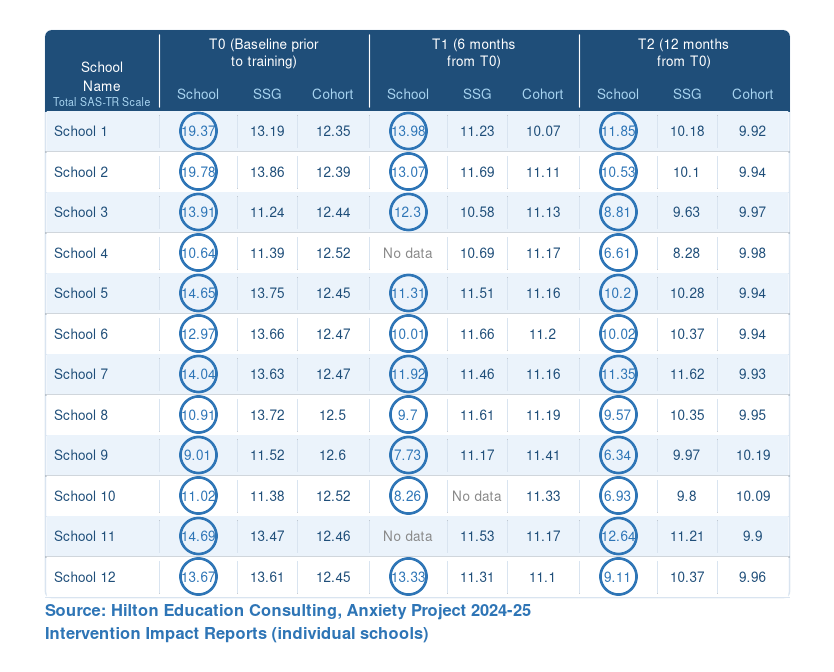
Data collected through the 2024-25 kids measure show a decrease in anxiety presentation as reported by teachers
The circled figures represent each school's own scores on the Total SAS-TR Scale — a validated measure of how anxiety presents in the classroom. At baseline (T0), most schools were sitting well above both the SSG and cohort averages, with some schools recording scores as high as 19.78. By T1 (six months after training) and T2 (twelve months), those same schools had brought their scores down significantly, in several cases, to below the broader cohort average. The improvement isn't incidental. It happens when whole-school change is given the time and the tools to take hold.
TEACHERS
Teacher confidence to recognise anxiety increased from 43.8% to 66.4% in 2023-2024.
This isn't just a shift in perception. It reflects teachers developing real, practised skills, and staying with them over time.
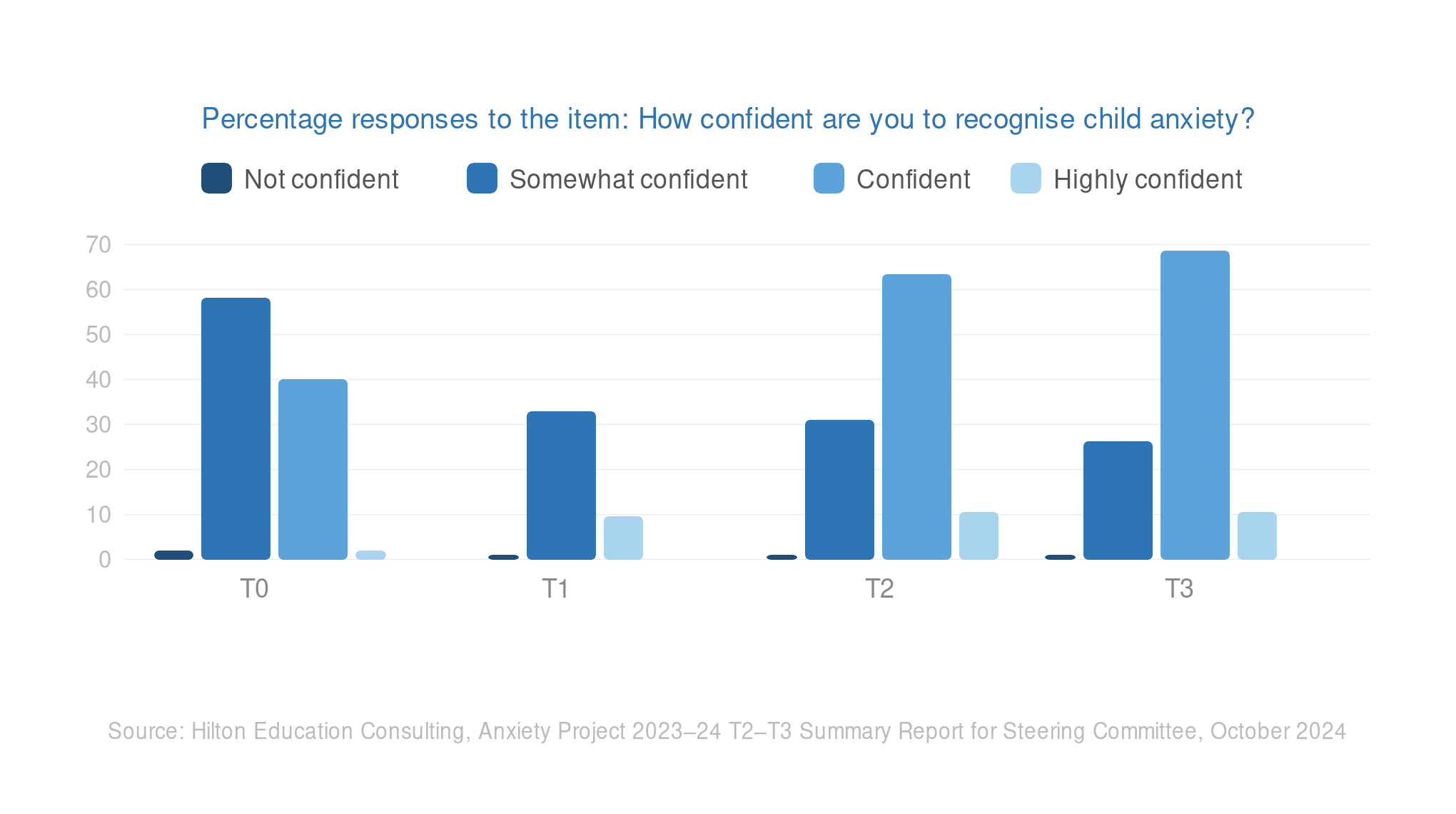
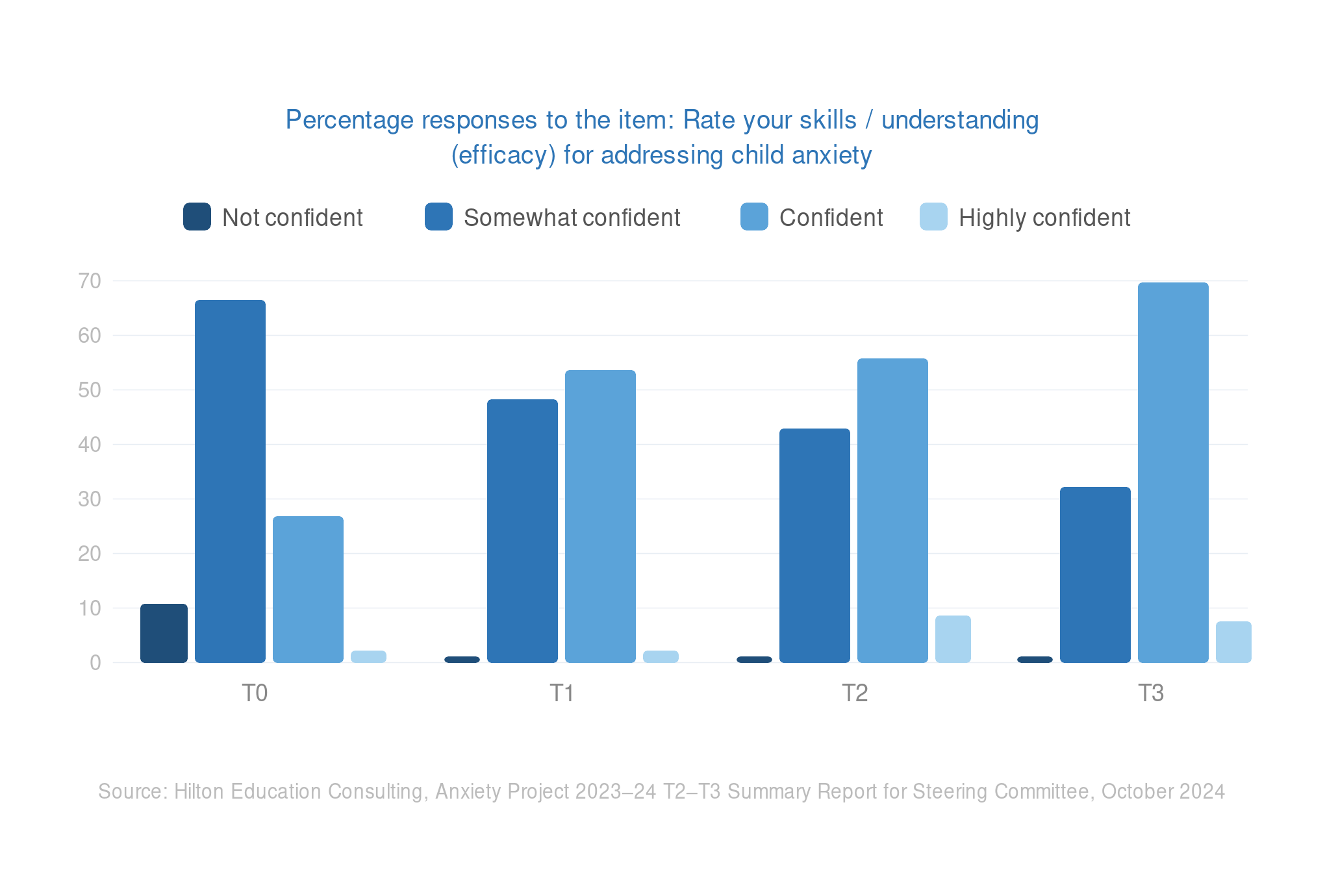
At baseline (T0), most teachers rated themselves as only somewhat confident in their skills to address child anxiety — with around 10% not confident at all. By T3, that picture had shifted substantially: the proportion of teachers feeling genuinely confident rose from roughly 27% to nearly 70%, while those feeling not confident dropped to almost zero.
At baseline, 10% of teachers felt not confident and 66% only somewhat confident in their skills to address child anxiety. Across four measurement points — from training through to 12 months later — that profile shifted decisively. By T3, 70% of teachers rated themselves as confident, with highly confident responses also growing. The proportion feeling not confident dropped to near zero.
PARENTS
Parent accommodation of child anxiety fell from a total score of 13.00 to 10.98 in 2023–24.
This data measures parent accommodation, the well-intentioned but unhelpful ways parents can enable a child's anxiety rather than help them through it. Lower scores mean less accommodation, which is the goal.
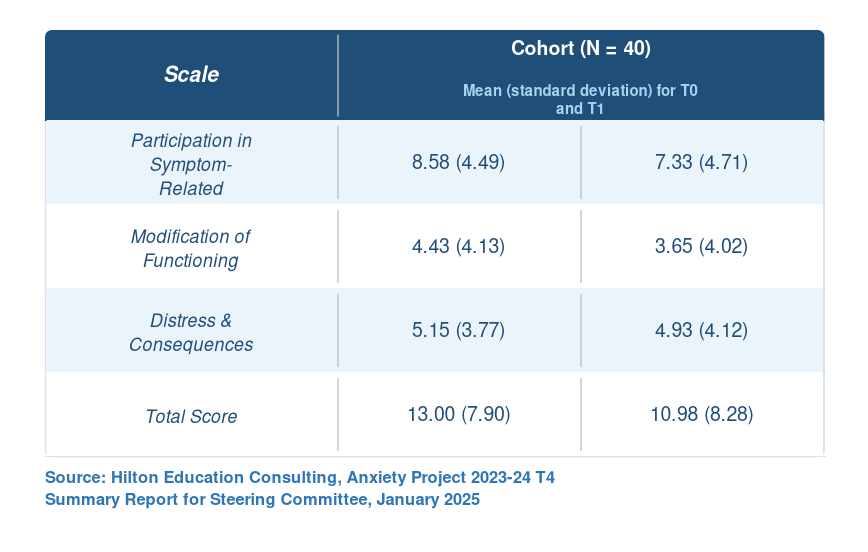
Across all three scales and for the cohort of 40 parents, scores dropped from T0 to T1. The total score fell from 13.00 to 10.98 — a meaningful reduction in just six months. The largest shift was in Participation in Symptom-Related behaviours, where parents showed the biggest change in how they respond when their child is anxious.
Our Mission
Reduce anxiety
Reduce anxiety, and build resilience in young Australians.
Child resilience
Improve child mental health to improve learning and life outcomes.
School response
Provide school leaders, teachers, and school staff with the skills, and knowledge to respond to individual child anxiety issues.
Parent support
Skill parents in how to support their child in the growth of emotional management skills, rather than solving the problem for them.

What makes The Anxiety Project different
A whole-system approach to culture change
Most programs focus on the individual child. The Anxiety Project works differently. It uses population-level change strategies — the same approaches applied by the UN to shift community behaviour at scale — to change the culture around anxiety in your school. When the adults around children respond differently, anxiety loses the conditions it needs to grow.
Ongoing support, not a one-day or one lesson event
Schools don't change after a single training day. That's why The Anxiety Project provides participating schools with structured, ongoing support through fortnightly Zoom Cafés across the life of the project — so staff can ask questions, share what's working, and stay connected to the approach as it takes root.
Evidence-based strategies taught in the classroom
The Anxiety Project brings CBT psychoeducation — including arousal reduction techniques, cognitive distortions, and interrupting strategies — into age-appropriate school lessons. These are the same tools ordinarily taught in therapy by a CBT clinician, now accessible to every student in your school.
Equipping parents and teachers, not just children
Teachers and parents are trained to use lay-led CBT strategies in everyday conversations: scaffolding children's problem-solving, helping them reframe challenges, and building the cognitive skills to face normal life difficulties with confidence.¹
¹ Research shows that parent-led CBT is as effective as therapist-led CBT for children experiencing mild to moderate anxiety.
We are not just a ‘fix-the-child’ solution. We focus on changing adult to child interactions intervening as a community, empowering staff and parents to make the needed impact.
Holistic Approach
By training one Implementation Coach that then trains teachers, principals, and parents to adjust already ongoing support without delays to teaching. We help teachers and parents who are already helping kids, do so more effectively.
Retooling Schools
This project puts parents in the driver’s seat, coaching parents via online cafes to feel confident with material and tools to support their kids at home. This ensures the intervention is holistic not just at school.
Parent
Engagement
To ensure the project can run itself once it is set up in the first place we empower staff at schools to teach the broader community new methods that address anxiety at a fundamental level.
Sustained
Outcomes
OTHER
PROJECTS
Often non-intervention based and impractical needing more psychologists than are available or affordably trainable.
Other interventions often take up school time and require large-scale and expensive training sessions with the entire staff. They often also struggle to run these training sessions at scale with a small team as there is more support needed.
Most wellbeing programs stop at the school gate. Parents, the adults children spend the most time with, are usually not included in their wellbeing initiatives, putting a lot of onerous responsibility on children and teachers.
Once programs are established it becomes difficult to maintain them year on year, and a lack of data collection at all schools can make it difficult to see if an impact is taking place.